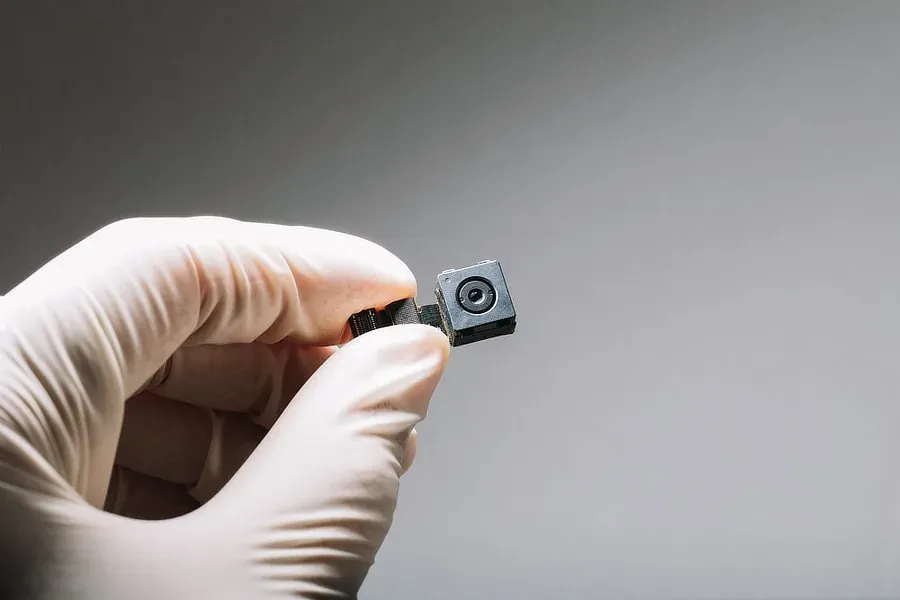
Are You Being Listened To? What If It's Happening Right Now?
Surveillance Technology in 2025
In 2025, surveillance technology has advanced to the point where conventional protection methods are often no longer sufficient. Modern eavesdropping devices operate in invisible frequency bands, leverage artificial intelligence, and combine sophisticated hardware and software tools.
Here is a detailed overview of eavesdropping devices and techniques that today represent the cutting edge.
A. Acoustic Eavesdropping
Acoustic eavesdropping is the foundation of espionage operations. Thanks to miniaturised microphones and advanced signal processing, modern devices are now capable of capturing even the faintest whisper through several layers of material.
Principle:
- Sound waves are captured by a microphone and converted into electrical signals. These are then transmitted, stored, or analysed.
Most advanced devices:
- MEMS microphones: Extremely small microphones (measuring just millimetres), integrated into everyday objects such as screws, pens, or wall sockets.
- Laser microphones: These use laser beams directed at vibrations on glass surfaces, such as windows. Modern systems can filter out interference such as wind and capture sound from tens of metres away.
- Piezoelectric contact microphones: These microphones, attached directly to a solid surface (e.g. pipes, walls), use the piezoelectric effect to convert vibrations into electrical signals. They are well suited to monitoring through walls or sealed rooms.
New trends:
- Adaptive filters: Devices with advanced artificial intelligence can distinguish the human voice from ambient noise, such as fans or footsteps.
- Wireless transmission: Miniature microphones now routinely incorporate Bluetooth or Wi-Fi modules for real-time data transmission.
B. Radio Eavesdropping
Radio eavesdropping in 2025 operates across a wide spectrum of frequencies, from classic RF bands to 5G and IoT protocols. With the proliferation of SDR (Software Defined Radio), attackers can easily monitor and manipulate communications.
- Captured data is transmitted on a specific frequency monitored by a receiver. These devices often operate on unencrypted bands, which increases the risk of detection.
- SDR (Software Defined Radio): Software-defined radio capable of monitoring a wide frequency range (from kHz to GHz). Used by both attackers and security professionals.
- IoT eavesdropping: Bugs that exploit poorly secured IoT devices (smart bulbs, thermostats) as a gateway to access sensitive information.
- GSM bugs: Miniature devices fitted with a SIM card that transmit data via mobile networks. Newer versions can change the SIM card identity, making them harder to trace.
- Exploitation of 5G networks: Attackers exploit low latency and high bandwidth to transmit eavesdropped data over long distances without loss of quality.
- Hybrid technology: Combining Bluetooth, Wi-Fi, and radio transmissions increases resistance to detection.
C. Software-Based Eavesdropping
Software has become the most dangerous tool of espionage. Modern spyware can take control of a victim's device without being detected by antivirus software.
- Infecting a device (mobile phone, computer, IoT device) with malicious software designed to gain access to the microphone, camera, or data.
Techniques:
- Zero-click exploits: Attacks that require no user interaction whatsoever (e.g. simply receiving a message). They frequently exploit vulnerabilities in messaging applications such as WhatsApp or iMessage.
- Next-generation spyware: Tools such as Pegasus can monitor calls, messages, and the victim's location in real time.
- Cloud monitoring: Eavesdropping on data stored in cloud services or during transmission.
- AI-based malware: Malicious programmes that use artificial intelligence to conceal their activities and evade detection.
- Exploitation of IoT devices: For example, eavesdropping on smart speakers (Amazon Echo, Google Nest).
D. Electromagnetic Eavesdropping
Thanks to sensitive technology, in 2025 it is possible to capture electromagnetic emissions not only from CRT and LCD screens, but also from keyboards, power supplies, and USB devices.
- Electromagnetic emissions from electronic devices are captured and reconstructed into a readable form.
Most advanced techniques:
- TEMPEST: Capturing emissions from screens and keyboards.
- Side-channel attacks: Exploiting data leakage from power cables or Wi-Fi signals.
- EME (Electromagnetic Eavesdropping): Highly sensitive devices capable of tracking the electromagnetic "fingerprint" of every device.
Artificial Intelligence in Surveillance
Principle: The integration of artificial intelligence (AI) into eavesdropping devices enables automated analysis and interpretation of captured data in real time. AI can identify key information, recognise voices, and even predict future communications based on patterns.
Examples:
- AI voice analysers: Capable of recognising specific voices and keywords from a large volume of intercepted conversations.
- Predictive communication analysis: AI systems that predict future communication patterns and potential security threats based on historical data.
Science fiction is no longer science fiction — soon you may need to protect your very thoughts. After the trade fair in Tel Aviv, I will write a more in-depth technical article, around the end of April, in which we will go through the absolute latest developments.
3. Biometric Eavesdropping
Principle: The use of biometric data for surveillance involves monitoring physiological signals such as heart rate, breathing rate, or even brain activity, with the aim of obtaining information about an individual's emotional state or intentions.
- Remote heart rate monitoring: Using laser or radio technologies to detect heart rate at a distance, which can reveal stress or deception.
- Micro-expression analysis using AI: A combination of camera systems and AI for detecting and analysing barely perceptible changes in facial expression that can reveal hidden emotions or intentions.
Do You Suspect Eavesdropping? How to Find a Bug?
1. Comprehensive Detection Audit:
We will survey your premises using everything from spectrum analysers to advanced TSCM tools. We will locate hidden bugs, laser microphones, and unauthorised transmitters that may be threatening your company or premises.
2. Protection Against Advanced Attacks:
- Installation of audio jammers: We generate white noise that effectively disrupts acoustic eavesdropping attempts.
- Electromagnetic shielding: Protects your devices against TEMPEST-type eavesdropping.
- Cryptographic solutions: Encrypted calls, messages, and data protection.
- We will carry out a physical audit and inspect your vehicle — see Vehicle Eavesdropping.
3. Regular Monitoring and Training:
- We will train you and your team to detect threats at an early stage.
- We offer training programmes that prepare you for the latest attacker tactics.